
Cooling decides how much load a transformer carries continuously, how much noise it makes, and what the cooling plant costs to keep running. The four letters on the rating plate, ONAN, ONAF, OFAF and ODAF, describe how the windings are cooled, how the oil moves, and how many ratings the unit has. Getting them wrong at enquiry stage is one of the common reasons two bids come back impossible to compare.
Written for engineers and procurement managers specifying power transformers for utility, industrial and renewable work. If you are still choosing between technologies, start with our comparison of power and distribution transformers.
What the four letters mean
IEC 60076-2 defines the designation, and reading it left to right answers one question at a time.
The first letter is the cooling medium touching the windings. O means a mineral oil or synthetic insulating liquid with a fire point of 300 °C or less, K means an insulating liquid with a fire point above 300 °C, and L means one with no measurable fire point. Dry-type units use A for air and fall under IEC 60076-11.
The second letter is how that medium circulates. N is natural convection, F is forced circulation through the cooling equipment, which means pumps, and D is forced circulation directed through the windings instead of around them.
The third letter is the external medium that carries the heat away, air (A) or water (W). The fourth is how that external medium moves, natural convection (N) or forced (F), meaning fans for air and pumps for water.
ONAN therefore reads as oil natural, air natural. ONAF is oil natural with air forced. OFAF is oil forced with air forced. ODAF is oil directed with air forced. Water-cooled versions, OFWF and ODWF, turn up where water is available and air cooling is ruled out by space or noise. Dry-type units are AN or AF.
ONAN and ONAF: the stages most buyers specify
ONAN has no moving parts. Heat passes from the windings into the oil, the oil rises by convection through the radiators, and air moves across the radiator surface the same way. This is the base rating, and it is what you still have if every auxiliary supply on the site fails. Choose it where reliability outranks footprint, where noise limits are tight, or where there is no dependable auxiliary power. The penalty is radiator area, since a naturally cooled design of a given rating needs more of it.
ONAF leaves the oil circulating naturally and blows air across the radiators with fans, which adds a second and higher rating to the same tank. Most 35–110 kV substation transformers use it, because it buys headroom for peak loading without the cost of pumps. What you take on is auxiliary equipment, meaning motors, starters, controls, bearings and a stock of spares, plus fan noise. State the guaranteed sound level with the fans running, not only with them stopped.
OFAF and ODAF: pumped and directed oil
OFAF adds pumps. Oil is driven through external coolers instead of relying on convection, and fans force air across them. Rejecting heat away from the tank lets the coolers sit remotely, which helps when the bay is cramped or the unit is indoors. The price is a larger auxiliary load and a longer maintenance list.
ODAF goes further by directing the oil through the winding ducts rather than letting it find its own path. Better heat transfer out of the windings is what allows a higher rating from the same core and coil assembly, so ODAF appears at the top of the rating range and on projects that need maximum output from a restricted footprint or transport envelope.
Buyers regularly underestimate the dependency that comes with it. At the upper stage the pumps run continuously, and when they stop the transformer drops to whatever its natural cooling can sustain. Write that reduced rating into the specification, along with how long it may be carried and the instrumentation that shows the operator it is happening.
Where each cooling method is used
| Designation | How heat is removed | Typical application | What it costs you |
|---|---|---|---|
| ONAN | Natural oil convection to radiators, natural air convection | Base rating of most oil-filled units; remote sites, indoor bays, noise-sensitive locations | No fans or pumps to maintain; larger radiator area |
| ONAF | Natural oil convection, fans blow air over radiators | Standard second stage for 35–110 kV substation transformers | Fan motors, controls and spares; fan noise |
| OFAF | Oil pumped through coolers, air forced across them | Larger ratings, restricted bays, remotely mounted coolers | Pumps and fans, more auxiliary power and upkeep |
| ODAF | Oil pumped and directed through the winding ducts | Upper ratings where winding hot-spot control governs the design | Highest auxiliary dependency; pumps run at the upper stage |
| OFWF / ODWF | Oil pumped, heat rejected to water | Indoor or underground substations with water available | Water treatment, leak detection, corrosion monitoring |
| AN / AF (dry type) | Air natural or air forced over the windings | Indoor substations, commercial buildings, fire-sensitive sites | No oil; the AF stage needs controls and air paths |
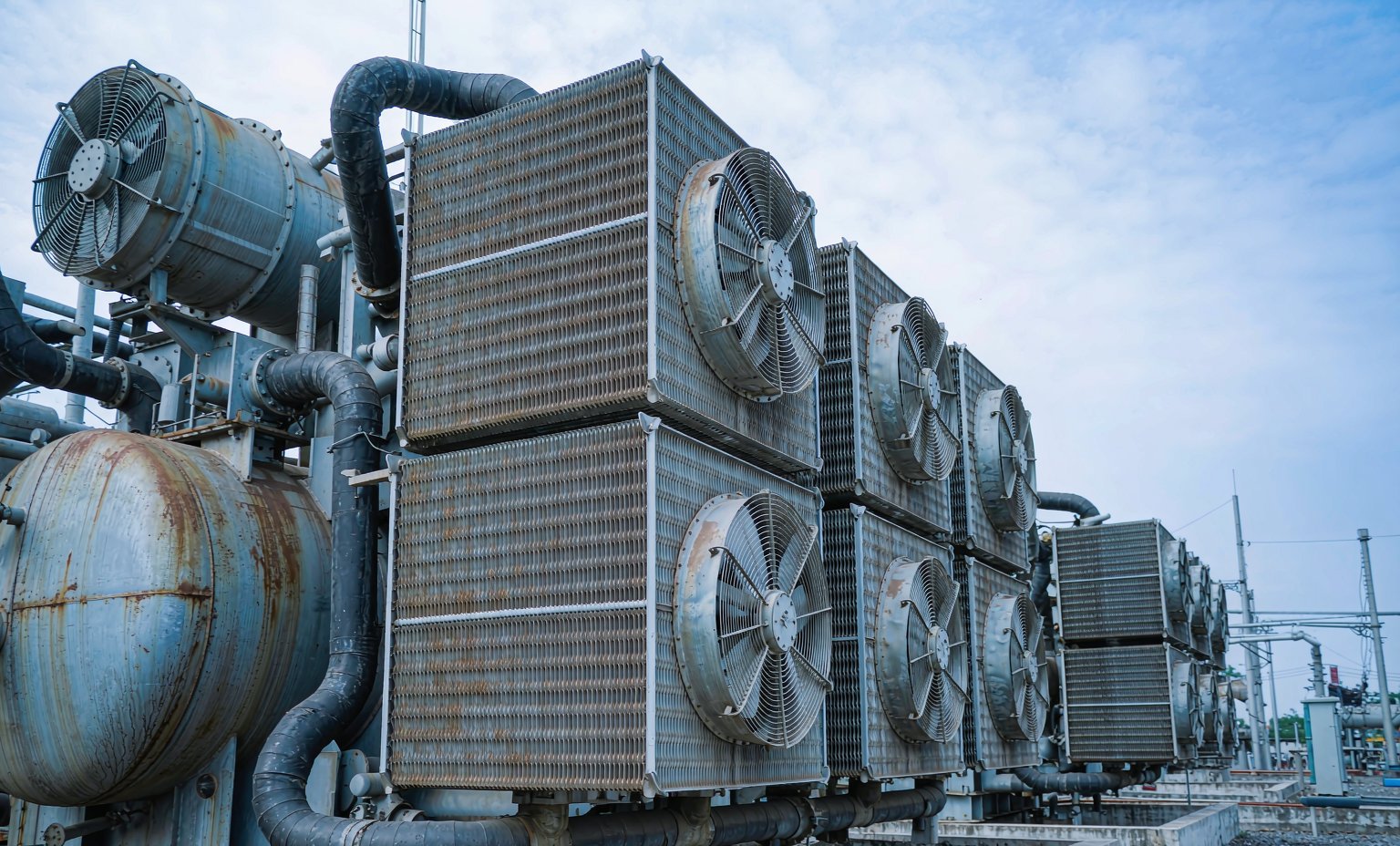
Reading cooling stages on a rating plate
A plate can carry one power rating per cooling stage. The lowest applies indefinitely with no cooling equipment in service, and every higher stage applies only while its fans or pumps run.
Losses change with the stage, because fan and pump motors draw power, so a guarantee given at a single stage makes bids impossible to compare. Ask for the auxiliary loss of each stage separately. Temperature rise is tied to a stage as well: IEC 60076-2 defines the test and the limits, and IEC 60076-7 covers loading beyond the nameplate rating. Name the stage the guarantee applies to in the technical schedule.
Projects run to North American practice use IEEE C57.12.00 and the IEEE C57.91 loading guide for the same purpose.
How to specify cooling on a datasheet
Nine fields settle almost every cooling question. Put them in the enquiry and the answers come back comparable.
| Item | What to state | Why it matters |
|---|---|---|
| Cooling designation | ONAN, ONAN/ONAF, OFAF or ODAF as applicable, to IEC 60076-2 | Fixes the design and the number of rating stages |
| Rated power per stage | MVA at each cooling stage | Removes ambiguity about the output being guaranteed |
| Ambient conditions | Maximum and minimum ambient, altitude, indoor or outdoor, solar exposure | Temperature rise is measured against ambient; altitude reduces air density |
| Temperature rise limits | Referenced to IEC 60076-2 or the applicable IEEE standard | Basis of the thermal design and the guarantee |
| Auxiliary supply | Voltage, phases and frequency for fan and pump motors | Motors bought for the wrong supply are a commissioning failure |
| Control scheme | Automatic start from winding temperature or load, manual override, alarms | Determines when the upper stage engages |
| Redundancy | Number of fan or pump groups, behavior on loss of one group, resulting rating | Defines the output still available after a single failure |
| Noise level | Guaranteed sound level with and without fans running | Fan noise is the usual source of community complaints |
| Access for maintenance | Clearances around radiators, removable fan guards, isolation per group | Decides whether a fan can be changed without an outage |
Controls, redundancy and site conditions
Controls are where the design meets the operator. A winding temperature indicator or a load signal starts the fans, a top-oil thermometer gives a second view, and both should feed alarm and trip contacts into the substation control system. Ask for a manual override, and for indication in the control room of which cooling group is actually running rather than which one has been commanded to run.
Altitude, ambient temperature and enclosure ventilation move the cooling choice more than anything else in the enquiry. Air density falls with altitude, so cooling capacity falls with it. A high ambient temperature eats into the temperature rise margin, and the applicable derating should come from IEC 60076-2 and IEC 60076-7 together with the manufacturer’s data for the specific design rather than a rule of thumb. If the radiators discharge into a room or an enclosure, that space needs its own ventilation path, and an undersized opening cancels the benefit of every fan on the tank.
Salt, desert dust and industrial contamination foul fin surfaces and reduce heat transfer over the years. Where any of these apply, specify a cleaning interval and, for enclosed units, filtration on the air intake.
FAQ
What is the difference between the ONAN and ONAF ratings on a plate?
ONAN is what the transformer carries with no cooling equipment in service, cooled by natural oil and air circulation. ONAF is the higher figure available while the radiator fans run. Both are ratings of the same transformer, and the one that applies depends on what is in service.
When is OFAF or ODAF worth the extra cost over ONAF?
When footprint, transport envelope or winding hot-spot control is the constraint. Pumping and directing the oil removes heat more effectively from a given core and coil assembly. Otherwise ONAF is usually the simpler and more maintainable choice.
Can a transformer keep its full rating if the cooling fans fail?
No. It drops to the rating its natural cooling can sustain. Your specification should state that reduced rating, how long it may be carried, and the instrumentation that tells the operator the upper stage is unavailable.
Does the cooling method change the impedance or the losses?
Impedance comes from the winding and core geometry, so cooling leaves it alone. Losses do change, because fan and pump motors draw power. Require losses per stage, including auxiliary consumption.
How do I compare two suppliers quoting different cooling designations?
Compare what each bidder guarantees rather than the letters. Fix the continuous rating, the ambient conditions and the temperature rise standard in your enquiry, then require each bidder to state the rating available at each cooling stage with the losses attached.
Specify cooling alongside the rating
Send us the rating, ambient conditions, site altitude and the standards your project follows, and we will tell you which designation and staging the design should carry. The oil-immersed range covers most outdoor duty, the dry-type range suits indoor work, and you can request a quote with your technical schedule attached.