
Replacing a GSU transformer is rarely planned. It usually starts with something unwelcome — a dissolved gas trend that will not settle, a bushing that has failed twice, a turbine upgrade that needs more capacity, or a grid operator telling you the unit no longer meets the connection rules. Whatever triggers it, the project has the same shape: you cannot simply order another transformer of the same rating, because the plant, the network and the standards have all moved since the original was installed. This guide sets out the feasibility questions to settle first, the footprint and civil constraints that decide what fits, the plant and grid data a manufacturer needs before quoting, and the re-compliance work.
It is written for plant owners, EPC engineers and procurement teams working on generator step-up units in the 35–110 kV class, up to around 63 MVA. For background on how these units are specified from scratch, start with our generator step-up transformer guide.
Settle feasibility before you ask for a price
The first question is whether the unit needs replacing at all. Repair makes sense for a discrete problem on a transformer with measured life left — a leaking radiator, a failed cooler pump, a bushing replacement. Replacement becomes the better answer when the problem is systemic: recurring gas generation, insulation that has aged across the whole winding, obsolete bushings or tap changers with no spares, or a rating that no longer matches the generator output.
The condition evidence should come before the decision, not after it. Dissolved gas analysis trended over time, oil quality tests, winding resistance and insulation measurements, and a frequency response analysis against the original fingerprint tell you whether you are looking at one component or the whole insulation system. None of these are pass-fail; read together they decide the business case.
Weigh that against outage economics. If the plant is contracted to deliver, an unplanned failure costs far more than a planned replacement window, and that is usually where the argument ends.
Plant and grid data a manufacturer needs before quoting
A GSU is a bespoke unit: it is defined by the generator on one side and the network on the other. A quotation issued without the data below is a placeholder, and the number will move once the real information arrives. Collect these before you send the enquiry.
| Data required | Why it drives the design |
|---|---|
| Generator rating, voltage, power factor and reactive capability curve | Sets the MVA rating, the required tap range and whether the unit can meet the generator’s reactive output at full load |
| Existing unit nameplate, vector group and impedance | Baseline for matching or deliberately changing the connection and the short-circuit contribution |
| HV system voltage, insulation levels and clearances | Determines insulation coordination and bushing selection to the applicable IEC insulation level |
| Present short-circuit level and X/R at the HV bus | Networks are usually stronger than when the unit was installed; the replacement must withstand today’s fault duty |
| Neutral earthing arrangement on both windings | Governs earth fault protection, insulation grading and the neutral terminal hardware |
| Generator excitation and AVR interface requirements | Decides how voltage control is coordinated with the tap changer |
| Auxiliary supply requirements | Whether a separate auxiliary transformer feeds the station services or tertiary winding connection is used |
| Ambient conditions, altitude, seismic and corrosion class | Affects cooling provision, external clearances and enclosure specification |
| Site layout, existing plinth, rail or road access | The practical answer to whether the new unit physically fits — see the next section |
| Fire protection, oil containment and environmental rules | Requirements that have usually tightened since the original installation |
Footprint: the constraint that decides what fits
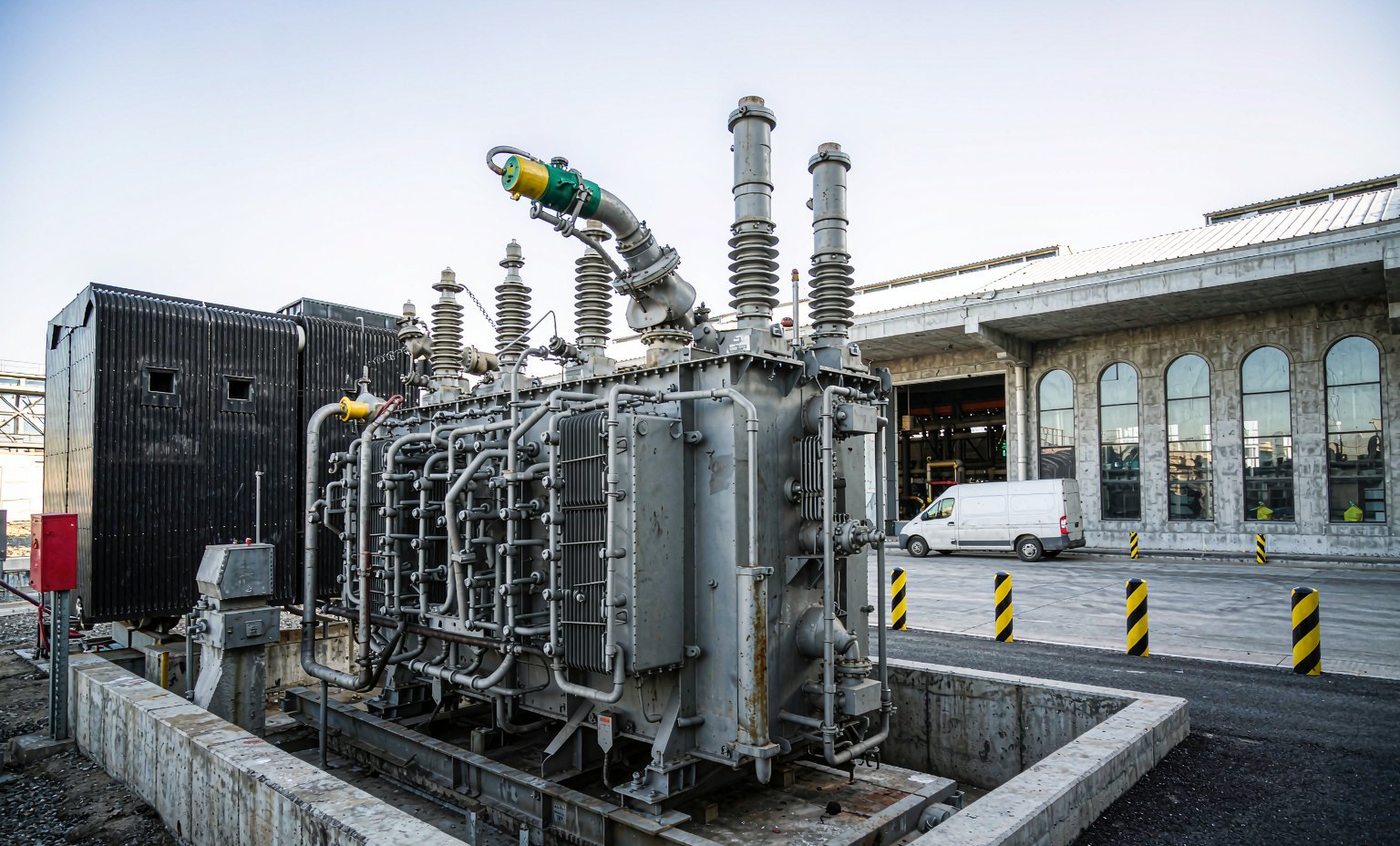
Almost every replacement discovers that the new unit is not the same shape as the old one. Even at an identical rating, modern requirements for cooling provision, terminal clearances, fire separation and instrumentation change the outline. Check the following against actual site measurements, not against the original drawings, which frequently do not match what was built:
- Plinth and rail centres — new outline drawing against the existing foundation, including bolt or rail positions.
- HV connection geometry — bushing or cable box positions relative to the existing busbar, overhead line termination or cable sealing end. This is the most common expensive surprise.
- Cooler and radiator arrangement — bank-mounted, separately mounted or forced-cooled package, and where the airflow goes.
- Fire separation and bund — fire wall position, oil containment volume, drainage and the distance to neighbouring plant.
- Crane and haulage access — can a crawler crane stand where it needs to, and does the route carry the transport mass.
Do a physical survey and issue the drawing set with the enquiry. Where the outline cannot fit, the honest choices are to accept a revised rating, relocate the unit, or budget for civil modification — all of which are cheaper decided before manufacture than after delivery.
Grid re-compliance: what has changed since the original unit
Short-circuit duty and impedance
Fault levels rise. A network that was weak thirty years ago may now require the replacement to withstand a considerably higher through-fault duty, which affects winding design, bracing and the specified impedance. Ask for the present short-circuit study rather than reusing the impedance on the old nameplate, and confirm whether the grid operator requires a specific impedance to limit downstream duty.
Vector group and earthing
If the unit runs in parallel with other machines or must preserve an existing earthing philosophy, the vector group usually has to stay the same. Changing it alters zero-sequence paths, earth fault protection behaviour and possibly the whole site’s earthing design. Make the change only when there is a clear reason, and revisit every protection setting if you do.
Voltage control and tap changing
Confirm the tap range and step against the generator’s reactive capability and the expected HV voltage band. This is where coordination between the excitation system and the tap changer is agreed, and where a mismatch produces chronic hunting or an inability to export at full load.
Protection boundaries
Reconcile the unit and overall differential boundaries, generator stator earth fault coverage, restricted earth fault, backup distance or impedance protection, and the generator’s negative phase sequence and reverse power arrangements with the new unit’s CT locations and ratios. Anything wired to the old transformer’s terminal box needs re-terminating and re-testing.
Insulation coordination
Specify insulation levels and surge arrester ratings against the present system in line with the applicable IEC insulation coordination and IEC 60076-3 requirements, rather than assuming the original levels still apply.
Outage planning and heavy transport
Manufacture is measured in months from drawing approval, but it is rarely the longest lead item. Route surveys, permit approvals, civil modifications and the grid operator’s outage slot usually are. Sequence them early: the outage date should be booked against realistic milestones, not against a hoped-for delivery.
Plan the decommissioning too. Oil must be tested before disposal to establish whether it contains restricted contaminants, because that determines how it can be handled and what it costs to remove. The old unit may still have scrap value, which offsets part of the removal cost.
Commissioning and re-energisation
Require a defined site acceptance programme in the contract, agreed before the unit ships, and make sure the witness scope is stated. The typical sequence covers ratio, vector group and polarity verification, winding resistance, insulation measurements on windings and core, oil sampling for a baseline dissolved gas record, tap changer operation through the full range, protection stability checks including primary injection where applicable, and a frequency response fingerprint recorded at first energisation for future comparison. The replacement must comply with the IEC 60076 series; the site test programme is where you confirm it once installed.
On first energisation, plan for magnetising inrush and verify differential stability before loading. Bring the unit up in stages, hold at each stage, and compare readings against the factory data before proceeding.
Replacement readiness checklist
| Item | What to confirm before ordering |
|---|---|
| Condition assessment completed | DGA trend, oil results, electrical measurements and SFRA reviewed as one picture |
| Existing drawings and nameplate recovered | Including as-built drawings where they differ from the original issue |
| Short-circuit study refreshed | Present fault level and X/R, not the figures on the old nameplate |
| Vector group and earthing decision taken | Match or change, with the consequence recorded in writing |
| Protection settings reviewed | CT positions, ratios and boundaries reconciled with the new unit |
| Civil and plinth survey done | Physical measurements with HV connection geometry included |
| Transport route surveyed | Mass, dimensions, bridge and road limits, crane standing area |
| Fire and environmental compliance checked | Bund volume, separation distances, oil disposal classification |
| Manufacture and outage sequence agreed | Drawing approval dates, shipping window, grid outage slot |
| Site acceptance programme in the contract | Test list, witness scope and acceptance criteria agreed before shipment |
FAQ
Can a replacement GSU be built to exactly the same footprint?
Sometimes, but plan as though it cannot. Even at the same rating, changes in cooling arrangement, terminal clearances and fire provisions alter the outline. Measure the site, agree the outline drawing early, and treat “same as the old one” as a requirement to be proven rather than assumed.
Should I take the opportunity to increase the rating?
Only if the generator, the HV connection and the civils all support it. A higher rating means a larger unit, possibly higher fault duty and a re-check of the whole protection and clearance picture, so cost it as the mini-project it is rather than as a specification change.
Do the protection settings have to change?
Assume yes. Differential boundaries, CT ratios and earth fault coverage depend on the physical unit. Even where the electrical parameters are unchanged, the settings need re-verifying and recording as part of commissioning.
How long does a replacement project take?
Think in quarters rather than weeks. Manufacture follows drawing approval, but route surveys, permits, civil works and the network outage slot frequently dominate the programme, so build the schedule around the longest of those.
What do we do with the old unit?
Remove it under a plan that covers oil testing, handling and disposal in line with local environmental rules. If the oil is free of restricted contaminants and the copper and core steel are recoverable, the scrap value usually offsets part of the removal cost.
Get the data pack together before you send the enquiry
A GSU replacement succeeds or fails on information. Assemble the plant and grid data above, survey the site physically, and agree the outage sequence before you ask anyone for a number. If you are at that stage now, our team can review your data pack and flag gaps before it becomes a design problem. Read our practical approach to selecting a power plant transformer, review the power transformer range, or send your specification to info@xsdfftransformer.com — WhatsApp +85254162620.